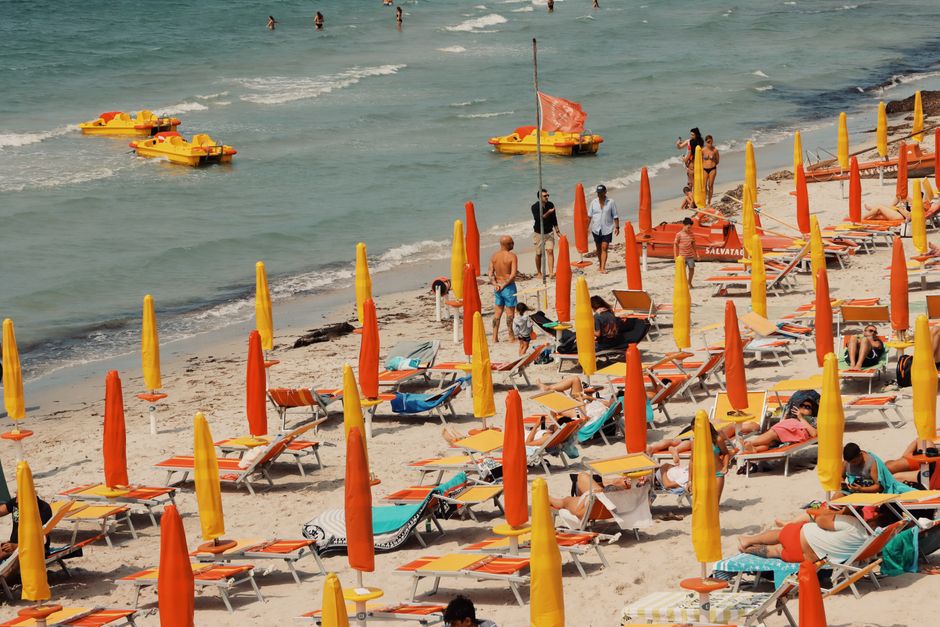
A towel can cause more trouble on a Mediterranean beach than a loud child. In many resort areas, visitors use towels to claim sunbeds before breakfast, then leave them empty for hours. Locals usually see that as selfish, not clever. The same pattern applies to topless bathing, music, smoking, photography and late-night noise: the acceptable behavior changes from one beach, town or hotel to the next.
There is no single Mediterranean beach rulebook. Use the signs at the entrance, follow the beach operator’s instructions and copy the behavior of respectful local swimmers. That simple approach works better than assuming Spain, Italy, Greece, France, Croatia and Turkey all share the same customs.
The safest Mediterranean beach rules are simple
Beach etiquette starts with one principle: public space belongs to everyone. Your towel, speaker, cooler or beach chair should not take more room or time than you are actually using. A crowded municipal beach has different expectations from a private beach club, a hotel pool or a designated naturist cove.
| Situation | Safest behavior | Reason |
|---|---|---|
| Claiming a sunbed | Use it while you are present; remove your towel when you leave. | Many resorts restrict unattended reservations. |
| Changing clothes | Use a changing booth, towel wrap or private facility. | Do not turn an open beach into a private changing room. |
| Topless bathing | Check signs and local patterns before removing a top. | Custom and local rules vary sharply. |
| Music | Use headphones or keep the volume low enough that nearby people cannot hear it. | Other visitors may want a quiet beach. |
| Smoking and rubbish | Follow beach signs and carry every cigarette end and wrapper away. | Some beaches ban smoking and protect sensitive habitats. |
The clear verdict: be present, quiet and tidy. If a beach has a printed rule, the printed rule wins over something you read on a travel forum. If there is no sign, choose the less intrusive option.
Topless bathing is local custom, not a Mediterranean guarantee
Topless bathing sits in a grey area for many travellers because social tolerance and legal permission are not the same thing. One beach may treat it as ordinary. A beach five kilometers away may attract families who expect more coverage. A resort may allow it by the pool but prohibit it on a public-facing terrace. Do not treat a country label as a complete answer.
France has clear naturist areas, but location still matters
France has a long-established naturist culture, yet full nudity is not automatically acceptable everywhere. France’s official tourism guidance says naturism should take place in areas specially designated for it, including certain beaches approved by local authorities. It also distinguishes between recognized naturist beaches and places that have developed a tolerant local custom. Check the municipal sign or beach operator before assuming a secluded-looking cove is clothing-optional. The official French tourism guidance on naturism is a useful starting point.
Italy, Spain and Greece require a beach-by-beach reading
Italy has recognized naturist locations, but a quiet stretch of coast is not automatically a legal nude beach. Italy’s tourism authority lists specific naturist and nudist beaches, including sites in Calabria, which is a better signal than relying on rumors. Spain has many beaches where topless bathing is socially common, but local municipalities and private venues can still set their own rules. Greece also has beaches known for relaxed swimming customs, but that does not give visitors permission to undress anywhere they choose.
For topless bathing, the practical rule is blunt: start covered, look for a clear local pattern, and do not make anyone else’s space part of your experiment. Never photograph strangers, stare, comment on bodies or treat a naturist beach as an attraction. At a designated naturist beach, a towel to sit on remains basic courtesy even when clothing is optional.
How to use a beach towel without annoying everyone
The towel is for sitting, drying and protecting your skin from hot sand. It is not a reservation flag, a fence or a way to occupy an entire row of loungers.
- Place it inside your real footprint. On a public beach, keep bags, shoes and towels close to your group. Do not spread out across empty space during busy hours.
- Ask before moving anything. If a towel or bag is on a chair, do not throw it onto the sand. Ask staff or a nearby guest whose it is. Some hotels remove unattended items; private action can create a needless argument.
- Follow the sunbed clock. Resorts often have their own limits, such as removing unattended towels after 30 minutes or banning reservations before a stated time. The exact limit is local, so read the sign.
- Use a second towel for hygiene. At a naturist beach, place a towel under your body when sitting on shared benches, beach bar seats or other communal surfaces.
- Shake sand away from people. Walk several meters downwind before snapping a towel. Sand in another group’s food is not harmless beach fun.
- Pack it out. A wet towel, plastic wrapper or cigarette end still belongs in your bag until you find the correct bin.
The worst mistake is arriving at 8 a.m., placing a towel on a prime lounger, and disappearing until lunch. That behavior creates conflict because it blocks access without using the seat. If you need a guaranteed lounger, book a managed beach club or hotel service that states its reservation policy. Do not invent one with a towel.
Quiet hours matter more than your holiday playlist
My recommendation is simple: treat a public beach as a shared quiet zone. Use headphones, keep conversations at normal speaking volume and turn off music during early mornings, meal times and the evening wind-down. A beach is not automatically a party venue because one bar has speakers.
Quiet hours are often set by the municipality, hotel, campground, apartment complex or beach concession. They may be written in a notice, posted at the entrance or explained by staff. They may also change by season. A beach bar can have permission to play music and still have limits on volume, hours or lighting.
Greece shows why blanket advice fails. Current Greek beach-concession rules require low and limited lighting when a business operates after sunset. For music and related uses, the published limits distinguish between concessions beside residential areas and those elsewhere, with a 50-decibel limit in the former case and an 80-decibel limit in the latter. Those figures apply to regulated concession activity, not as a universal permission for every visitor to run a loud speaker. The Greek Ministry guidance on beach users and concessions also covers cleanliness, public access and noise.
Do not assume afternoon silence is a legal Mediterranean-wide rule. In some places, the quiet period belongs to a hotel, pool or residential neighbourhood rather than the sand itself. The useful test is human, not technical: if people several meters away can clearly hear your music, it is too loud for a shared beach.
Common beach mistakes that create real friction
Most beach arguments start with small acts that visitors call harmless. They are not harmless when repeated by hundreds of people.
Can I take a photo on a topless or naturist beach?
Take landscape photos only after checking the setting. Keep people out of the frame where possible. Never point a phone or camera at a stranger, even if the person is far away or partly hidden by an umbrella. A naturist beach depends on privacy. Photography can make the space feel unsafe in seconds.
Can children play anywhere?
Children can play, but the group still owns its noise and sand. Keep ball games away from seated swimmers, avoid throwing sand near food and do not let inflatables drift through a marked swimming lane. If a beach has zones for water sports or swimmers, respect the boundaries. A lifeguard’s instruction outranks your plans.
Can I bring food, alcohol and a dog?
Rules differ. Some beaches allow packed food but ban glass. Some allow dogs only during specific months or hours. Some private beaches prohibit outside drinks. Read the entrance notice before unpacking. Smoking restrictions deserve special care because beaches near dunes, pine forest or protected habitats may impose stricter rules. France’s beach guidance, for example, tells visitors to check local conditions and monitoring information rather than assuming every beach operates the same way.
When should I leave?
Leave when staff ask, when the beach closes, when weather warnings change or when your group starts disturbing nearby people. Never cross barriers to reach a closed beach or protected nesting area for a better photograph. In Greece, official destination pages regularly warn visitors to check current access conditions at individual sites because closures and safety restrictions can change.
The strongest rule is also the easiest: do not make strangers manage your behavior for you. If your action would force a family, older swimmer or nearby resident to move, complain or clean up, change the action first.
